
Moving Past the Illusion of Control in Fuel Exception Reports
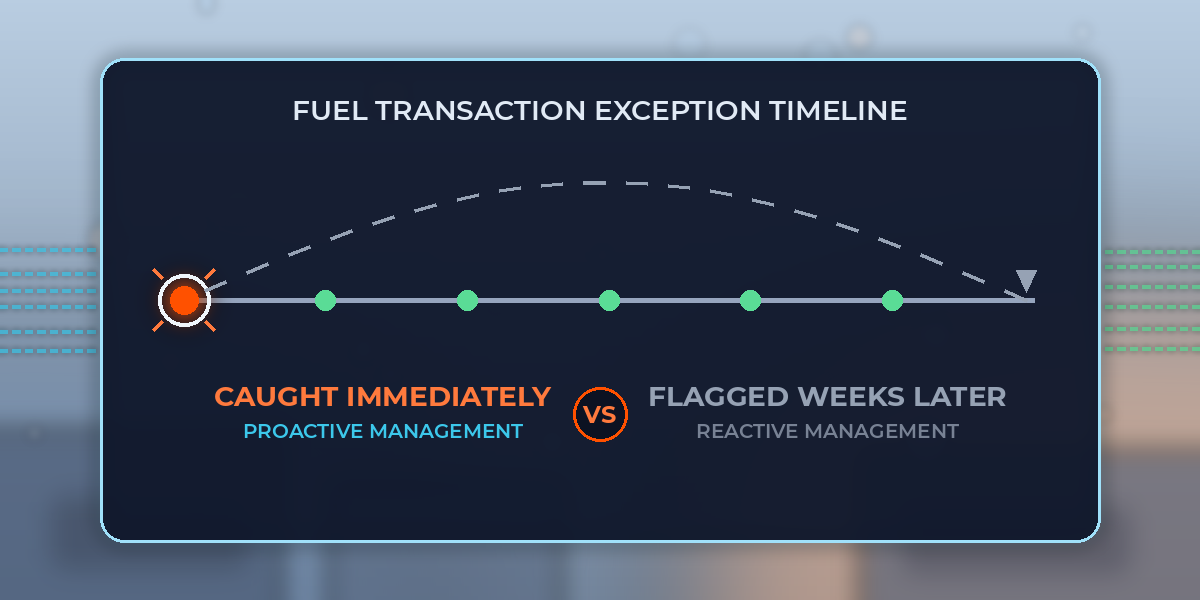
Exception reports have been a fixture in fleet fuel management for as long as I have been in this industry, and for most of that time they have been treated as a control mechanism. Flag the outliers, review the transactions, document the findings. The assumption is that this process provides corrective oversight.
What it actually provides is a record. And there is a significant difference between a record and a control. That difference has real consequences for how well your fuel program is actually managed versus how well it appears to be managed.
The Inherent Limitation of Reactive Reporting
By definition, an exception report looks backward. It analyzes transactions that have already occurred, identifies the ones that fell outside acceptable parameters, and queues them for human review. Don’t get me wrong, this process has value without a doubt but calling it a control is a stretch that organizations make because it feels active even though the activity is entirely retrospective.
A control stops the problem where an exception report describes it after the fact. If a driver fuels a vehicle at 11 PM on a Saturday for twice the normal volume, the exception report will catch it. But it will catch it on Monday morning, after the fuel has been dispensed, potentially after a second transaction has occurred, and after whatever was the underlying issue has had a full weekend to develop further.
The distinction matters more in some scenarios than others. For a low-frequency anomaly involving a small dollar amount, a few days of lag may be acceptable. For a pattern that repeats across multiple drivers or multiple vehicles, or for a transaction that involves a significant volume of fuel, the lag between occurrence and detection is not neutral. It is a window in which the problem intensifies.
How Much Time Is Actually Going Into Exception Review
One of the questions I ask fleet managers in my consulting work and in the 100 Best Fleets review process is how much staff time goes into weekly exception report review. The answers are often surprising, not because the number is large in absolute terms, but because the activity is so thoroughly habitual that most organizations have never actually calculated time consumed or what it costs.
A fleet with 500 vehicles running a weekly exception review process, routing flagged items to supervisors, collecting responses, and reconciling records might easily spend ten to fifteen staff hours per week on that cycle. That is not a line item anyone has budgeted explicitly. It is invisible labor absorbed into everyone’s workload. Multiply that by 52 weeks and you are looking at a substantial annual cost for a process that, at its best, documents what went wrong after it already went wrong.
I am not suggesting that staff time is being wasted in a careless sense. The people doing this work are doing what the system requires. The point is that the system is requiring them to do work that could be largely eliminated with the right upfront controls, and the total cost of that eliminated work would fund the system improvement many times over.
The False Sense of Control
Here is the deeper problem. Exception reporting creates an organizational sense that the fuel program is being managed, because reports are being generated, reviewed, and filed. Leadership sees output. The reports exist, the process is documented, findings are logged, and the program appears to have oversight control.
But oversight of completed transactions is not the same as control of active ones. The fleets I have seen run into serious fuel problems, misuse patterns that went on for months, anomalies that compounded before anyone caught them, were all running exception reports. The reports were being generated. They just were not stopping anything. The documentation created the appearance of management control without substance.
This is worth being honest about internally, even when it is uncomfortable. If your exception reporting process is your primary fuel control, you have a documentation system, not a management system. The upgrade worth making is to treat exception reporting as the secondary check it should be, layered on top of transaction-level controls that prevent the majority of problems before they become records.
Preventing Instead of Documenting
The transition from documentation to prevention requires a systems investment, but it does not require a dramatic operational overhaul. Modern fuel management systems can evaluate transactions against a defined rule set before the pump activates: checking tank capacity, transaction frequency, time of day, mileage since last fill, and other parameters. The system either flags the transaction for supervisor override or declines it outright.
That is a different conversation with finance and leadership. Instead of showing them the exceptions you caught last week, you show them the transactions that were declined this month because they did not pass the validation check. You show them the dollars those declines represent. The narrative shifts from reactive to proactive, and the credibility that comes with that shift is significant and durable.
Exception reports will always have a place in fleet fuel management. Reviewing them regularly remains a sound practice but their place is as a secondary check on a system that is already preventing problems, not as the primary mechanism of control. Organizations that understand this distinction, and act on it, operate consistently better than those that do not.